

WATER AND SEWAGE INFRASTRUCTURE | REHABILITATION OF WATER AND SEWAGE NETWORKS
We specialise in trenchless rehabilitation of water and sewage networks. We take an individual approach to each project, selecting the technology on the basis of the inspection and monitoring carried out beforehand. We have more than 20 years of experience and expertise in more than a dozen trenchless technologies to deliver to our customers. The most effective and state-of-the-art solutions. Our offer includes:
Technology description
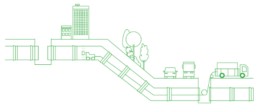
Technology for centrifugal rehabilitation of water supply infrastructure using Coverlan hybrid spray composite. It is a fast-setting, chemically curing coating based on polyurea resins, reinforced with basalt rock microfibres. Application
The specificity of Coverlan technology allows it to be applied to both straight sections of water pipes and curves, uniformly covering the inside of the pipe. As a result, the technology enables rehabilitation to be carried out without the need for excavation, allowing work to be conducted on longer pipe sections. For more information, visit coverlan.pl.
Technology description
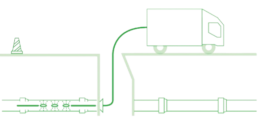
The trenchless sewage rehabilitation method involves inserting a fibreglass sleeve soaked in resin into the pipe, which is then cured using UV light. This creates an integral coating that fills and repairs the internal surface of the existing pipeline. With this solution, the number of excavations required can be reduced, and the sleeves can be installed through sewer hatches and maintenance holes. Application
CIPP technology is ideal for situations where the load-bearing capacity of the channel needs to be increased while minimising the diameter. The fibreglass of which the sleeve is made has very good structural properties, allowing the existing pipeline to be reinforced without the need for earthworks and resizing.
Diameter range
DN200 – DN1200 and non-circular pipes
Description of the technology
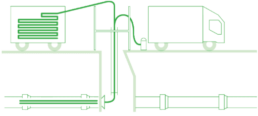
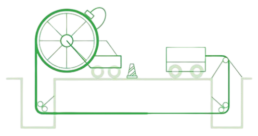
The CIPP technology for trenchless sewage rehabilitation involves locating a felt sleeve soaked in polyester resin within the sewer by means of inversion. For the installation of the sleeve, we use towers or an inversion drum, which allows us to use the static pressure of the water to distribute the felt evenly in the channel. Once the sleeve is in place, the resin is cured by heating the water in the sleeve to the appropriate temperature.
Application
Hot water-cured CIPP lining technology is recommended for areas with high groundwater levels. The specific nature of the technology allows it to be used in egg ducts and any duct with a non-standard structure. A method used without the need to excavate and divide the installation into sections. It is also worth noting that this method is used for non-pressure sewer networks.
Diameter range
DN200 – DN1200
Technology description
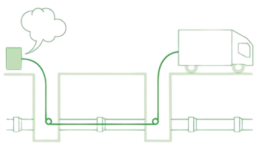
Trenchless sewage rehabilitation technology involves the installation of a steam-cured glass sleeve. This method shares all the characteristics of a UW radiation-cured glass sleeve, with the only difference being the initiator, which in this case is high temperature. The sleeve is inserted into the channel and then cured under hot steam under full monitoring of the work. A significant advantage of this sewage rehabilitation technique is the use of glass fibre material, which allows for a high value of circumferential stiffness.
Application
Hot steam-cured CIPP lining technology is used for straight sections of deteriorated pipe structures and a lack of groundwater.
Diameter range
DN200 – DN1200
Description of the technology
This simple, yet indispensable in many cases, technology involves the spot repair of leaks in the duct, using a resin carrier primarily composed of glass fibre impregnated with chemically hardening resins. Sewer rehabilitation is quick and inexpensive when the sewer is in good condition and only a small section of the pipe needs to be repaired.
Application
The Terlan Company has a professional set-up for packing technology, which allows spot repairs to be carried out efficiently. We are one of the few in Poland to offer spot repairs – egg duct packers.
Diameter range
DN200 – DN800
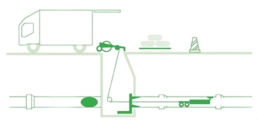
Description of the technology
This simple, but indispensable in many cases, technology consists of the spot repair of leaks in the duct, using a resin carrier of mainly glass fibre impregnated with chemically hardening resins. Sewer rehabilitation is quick and inexpensive when the sewer is in good condition and only a small section of the pipe needs to be repaired.
Application
The Terlan Company has a professional set-up for packing technology, which allows spot repairs to be carried out efficiently. We are one of the few in Poland to offer spot repairs – egg duct packers.
Diameter range
DN200 – DN800
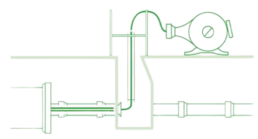
Description of the technology
Relining technology (often referred to as slipling) involves inserting long sections of polyethylene pipe into the network to be repaired. The butt-welded pipes are pulled into the pipe, which has been cleared of unnecessary sediment. The project, completed in this way, represents a new, integral water supply network that retains all the technical parameters of the original network.
Application
The relining method is applicable to both sewer networks and water mains.
Diameter range
All possible
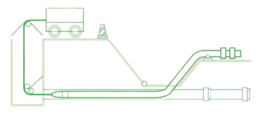
Description of the technology
Relining with GRP modules is used for the rehabilitation of sewer interceptors with circular and non-circular cross-sections. It involves installing new, made-to-measure GRP modules inside the duct. The module should be selected in a way that minimises the primary retention of the channel as much as possible. The space between the old and new canals is filled with a special injector.
Application
The GRP module relining method is applicable to sewer networks.
Diameter range
All possible

Technology description
In this method, the existing pipeline is crushed and cut using a special head and winches. With the help of hydraulic pulling equipment, the pipeline to be rehabilitated is replaced by a new pipe, which is pulled directly behind the head. Jet is the only technology that allows the diameter of the existing duct to be increased. The method does not require a cleaning process for the existing duct.
Application
The static cracking method is applicable to water mains and is used when pipe diameters need to be increased and when they need to be completely rehabilitated.
Diameter range
63-300 mm
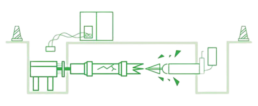
Technology description
This is one variation of the technology used for trenchless rehabilitation of water mains. It is characterised by the use of a special, factory-prepared polyethylene pipe that is formed into a U-shape. This well-known rehabilitation method enables the walls of the two pipes to be closely aligned, resulting in an almost imperceptible reduction in the diameter of the pipe.
Application
Method used in limited areas of operation. Often chosen when a complete reconstruction of the pipe structure is required.
Diameter range
150-500 mm
Monitoring the water and sewage network plays a crucial role in maintaining the system’s efficiency and ensuring the performance of the water and sewage infrastructure. It enables real-time monitoring and management of the network, as well as the identification of potential problems, facilitating quick intervention and minimising the risk of failure.
Terlan uses various technologies to monitor the water and sewage network, such as:
- CCTV camera monitoring, which allows monitoring and recording of images from the detection field in an enclosed area.
- Smartball monitoring, which allows sewer inspections to detect leaks and anomalies without having to shut off the flow.